Choosing well
How to Tell Real Wildcrafted Sea Moss From the Rest
Pool-grown, dyed, bulked out with salt: the sea moss market has a quality problem. Here's what to look at before you buy, including how to read what a seller doesn't say.

Sea moss went from obscure sea vegetable to viral wellness product in about three years. Supply chains don't adapt that fast honestly. The result is a market where the same shelf holds wild-harvested moss and pool-grown, dyed, salt-bulked product at similar prices, with similar words on the label.
Here's what to actually look at.
1. Wild-harvested vs pool-grown
Wildcrafted generally means the plant grew on its own in the ocean and was gathered from the wild — traditionally gathered from the rock at low tide.
Pool-grown (sometimes “cultivated” or “farmed”) means it was propagated in controlled water — in tanks, in pools or on lines, frequently in warm water. It is generally quicker to produce, which is part of why it tends to cost less.
Farming sea moss isn't a scandal. But the two are not the same product, and the mineral profile of a plant reflects the water it grew in. The catch is that “wildcrafted” is a word anyone can print, with no certification behind it. Which brings us to the real test.
2. What it looks like
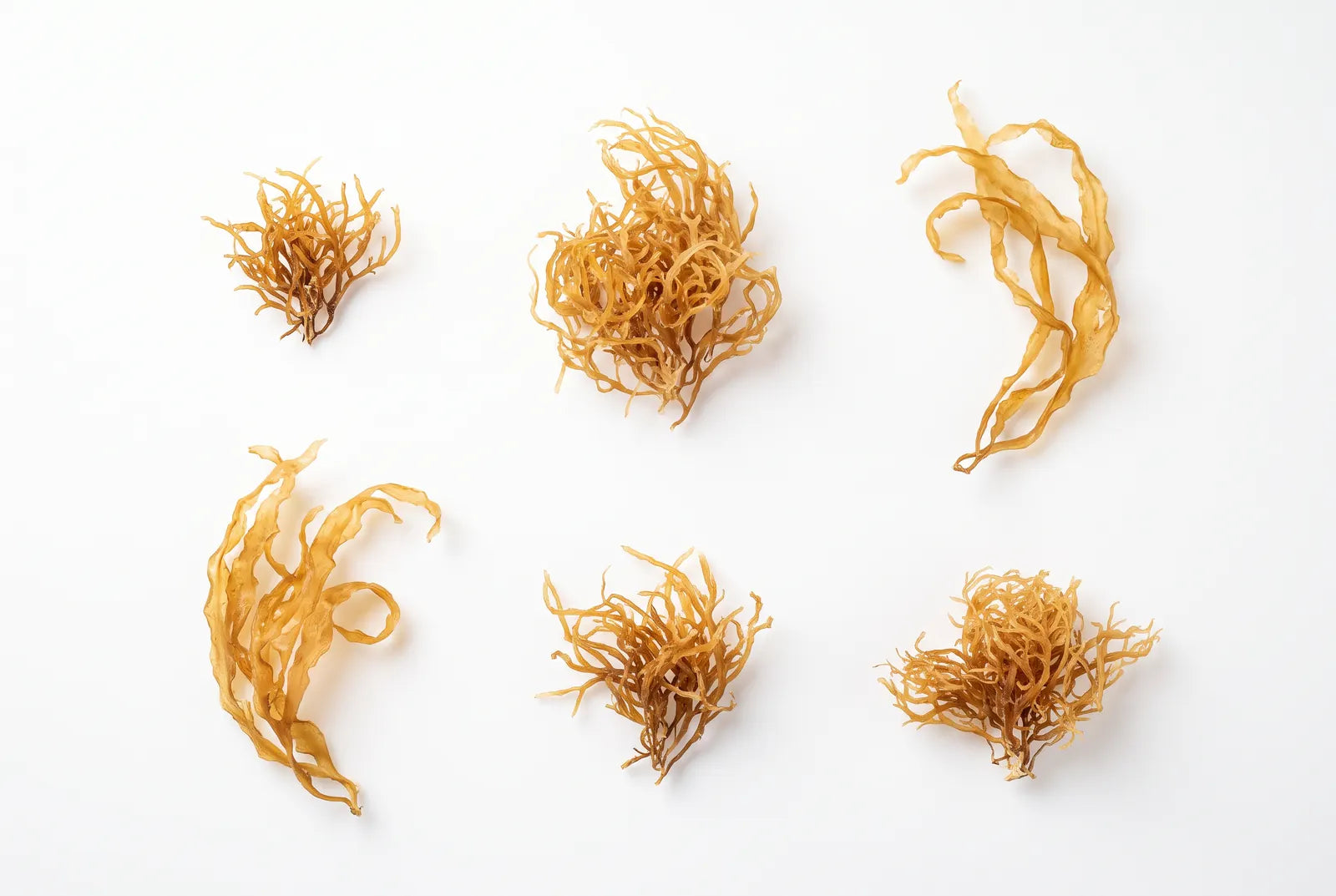
This part applies to dried, whole sea moss — once it's blended into gel, you can't see any of it. Wild Atlantic sea moss, such as Chondrus crispus (the plant “Irish moss” traditionally refers to), is:
- Flat and branching, like a fan splitting into fingers — not stringy or noodle-like
- Translucent, so light passes through the fronds
- Muted — dusty rose, pale gold, deep purple, sometimes almost colorless
- Inconsistent within a batch, because it grew in different spots and different light
Flags worth noticing:
- Vivid, uniform color across every piece. Nature isn't that tidy. Bright, even color across a whole bag often means dye.
- A thick white crust. Sea moss is harvested from salt water and some salt is normal, but heavy salt is weight you're paying for and rinsing away.
- Bright green. Sea moss is a red alga. Green sea moss is usually a different species or a colored one.
3. What's in the gel
Sea moss gel is mostly water — that's what a gel is. So the real questions are how much moss went into it, and what else did.
Read the ingredient list. It should be short, and every ingredient should be named plainly enough that you can tell why it's there. If a product sold as pure sea moss gel lists something you can't identify, ask the seller what it's for.
For the record, our plain jar lists three: wildcrafted Irish sea moss, purified water and lime juice. Flavored jars add what the flavor is made of, and it is printed on the jar.
4. What the seller will tell you
This is the test that actually works, because it doesn't depend on you being an expert in algae.
Ask, or look for:
- Where was it harvested? A specific answer — a country, a coast, a region — not “the ocean.”
- Is there a batch analysis? Sea vegetables vary by harvest, so a lab result is most useful when it's tied to the lot you're holding. Ask whether the seller can show you one for your batch.
- What's the iodine content? The honest answer is a batch-specific figure, plus the advice to check with a doctor if you're pregnant, nursing, or manage a thyroid condition. A brand that skips that caveat is prioritizing the sale.
- What don't they claim? This is the quiet one. A seller who tells you sea moss contains “92 of the body's 102 minerals,” or that it does something for a disease, has already shown you they'll say what sells. Everything else on the label inherits that.
5. How it's stored
Read the storage instructions and follow them to the letter. A jar that doesn't tell you how to store it is a flag on its own. Ours says: keep refrigerated after opening.
How we answer the same questions
It seems fair to hold ourselves to the list above. Harvest: our label says wildcrafted Irish sea moss, sourced from Ireland. Ingredients: sea moss, purified water and lime juice. Batch analysis: not published yet — we're working with our maker to publish lab results for each batch. Claims: nothing about disease, and never the 92-minerals line.
The short version
You can't verify most of this by looking at a jar on a screen. What you can do is check whether a seller is specific — about origin, about testing, about what they don't know — because specificity is expensive to fake and vagueness is free.
Questions
What does wildcrafted sea moss mean?
It generally means the sea moss grew wild in the ocean and was gathered from the wild — traditionally gathered from the rock it grew on — rather than cultivated in a pool, a tank or on lines. It's a description of how it was grown and gathered, not a certification, which is why the rest of the seller's transparency matters.
How can I tell if sea moss is fake?
With dried sea moss, look at color and shape. Wild sea moss is flat, branching and translucent, in muted purples, golds and rose, and it varies within a batch. Uniform, vivid color across every piece is a flag. So is a heavy salt crust used to add weight, and so is a seller who can't tell you where it was harvested.
Is pool-grown sea moss bad?
It's a different product, not a scandal. Pool-grown moss is cultivated in controlled water, often grows faster and larger, and doesn't draw from the same mineral environment as wild ocean moss. The problem isn't that it exists — it's when it's sold as wildcrafted.
Why is some sea moss so cheap?
Usually because it's pool-grown, salt-heavy, or the gel has been thinned with water. A jar of gel is mostly water by nature, so how much actual moss went in is the variable that price is really measuring.
Does color tell you the quality?
No. Color reflects species and sun exposure, not grade. What color can hint at is authenticity: natural variation within a batch is a good sign, and unnaturally uniform, vivid color is not.