

The ingredient
What sea moss is, and what we know about it.

01
What it actually is
Sea moss is not a moss. It is a red alga — a seaweed — and the wild kind grows on rock in cold, moving water.

The name is used loosely. “Irish moss” traditionally means Chondrus crispus, which grows along the North Atlantic — the coasts of Ireland, Britain, Brittany, Nova Scotia and Maine — clinging to rock in the tidal zone, where it spends half its life underwater and half exposed to the air. It is flat, branching and translucent, somewhere between dusty rose, mauve and pale amber depending on how much light it gets. “Sea moss” is also used for several warm-water red algae, some of them farmed. The bright green sea moss you sometimes see online is usually a different species, or one photographed under a filter.
It has been eaten in Ireland and the Caribbean for centuries, mostly as a thickener: simmered, it sets into a gel as it cools. That gelling behavior comes from carrageenan, a family of carbohydrates these algae build into their cell walls. It is the reason sea moss becomes gel at all, and the reason it has been in kitchens far longer than it has been in supplement bottles.
That is the whole botanical story. It is a coastal plant with an unusual carbohydrate, and everything else on this page follows from that.
The names overlap more than most sellers admit. If you are comparing jars, start with Irish moss vs other sea moss.
02
How it's harvested
Our jar is labeled wildcrafted: gathered from the wild, not farmed. Here is what that word generally covers.

There are two ways to get sea moss. You can harvest it wild — wait for the tide to drop, walk out, and cut the fronds above the holdfast so the plant regrows. Or you can farm it, growing fragments on lines or in pools of warm, shallow water, often in the tropics, where it grows faster and larger.
Both produce sea moss. They do not produce the same sea moss. Farmed material is often a different species, raised in warmer water, and it tends to arrive pale, uniform and slightly rubbery. Wild fronds are usually smaller, darker and more variable — which is a nuisance for anyone who wants every batch to look identical.
Cutting above the holdfast matters. The holdfast is the disc that grips the rock; leave it and the plant grows back from it the following season. Pull the whole thing off and you have harvested that patch of coast exactly once. It is a fair question to put to any seller of wildcrafted sea moss.
03
How it becomes gel
There are two traditional ways to turn sea moss into something you can eat. Neither is complicated. What follows is a general account, not a description of any one maker's process.

The older Irish method uses heat. Dried moss is rinsed, then simmered in milk or water until the carrageenan dissolves out of the fronds. The liquid is strained and left to cool, and it sets as it cools — the basis of carrageen moss pudding, which Irish kitchens have made for generations. Heat releases the carrageenan; cooling sets it.
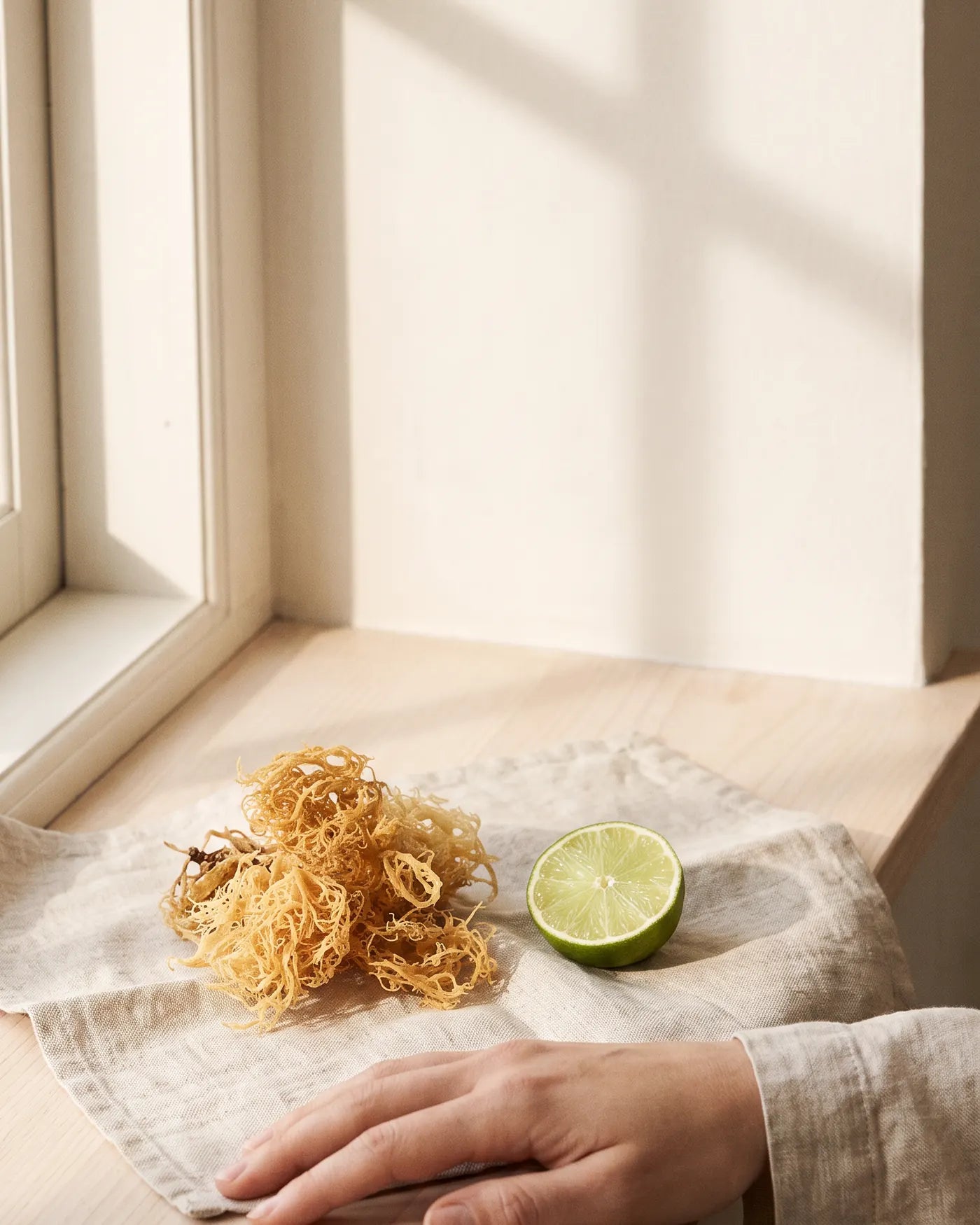
The gel most people buy today follows a different home method, common in Caribbean-style preparation. The dried moss is rinsed to clear salt and sand, soaked in water until it swells and softens, then blended with fresh water until smooth. It thickens further as it chills. Many recipes add a squeeze of lime.
What we can tell you about Gold Pure, our plainest jar, is what its label says: wildcrafted Irish sea moss, purified water and lime juice. Every ingredient is on the label. How our maker gets from one to the other is something we would rather describe from their documentation than guess at here.
Want to try it yourself? Here is how the gel is made at home.
04
About the iodine
Sea moss concentrates iodine from seawater. That is the most important thing on this page, and the reason some people should talk to a doctor first.
Iodine is a trace element that the body cannot make and has to get from food. Seaweeds are unusually good at accumulating it — they pull it out of seawater and hold it in their tissue at concentrations far above the surrounding water. That is a property of the plant, not a benefit we are claiming for you.
The consequence is that the iodine content of any seaweed varies. It changes with species, with the water it grew in, with the season, and with how it was handled after harvest. Two harvests from the same stretch of coast can differ meaningfully. So a single figure is only really meaningful when it comes from a laboratory analysis of a specific batch. We're working with our maker to publish lab results for each batch; until then, a batch analysis is a fair thing to ask any seller for, us included.
It is also why sea moss is not right for everyone. If you have a thyroid condition, take thyroid medication, or are pregnant or breastfeeding, talk to your doctor before adding sea moss to your routine — and take the label with you, so the conversation starts from the product in front of you rather than a guess.
Who should talk to a doctor first, and what too much feels like, are on one page: iodine, and who should ask first.
05
What we don't say
The most repeated claim about sea moss is not true, and we would rather lose the sale than repeat it.
If you have read anything about sea moss, you have met the number: a precise-sounding count of how many of the body's minerals it supposedly contains. It appears on packaging, in captions, in podcast ads. It has no scientific basis. Nobody has published an analysis behind it, the human body has no agreed list of required minerals to count against, and the figure seems to have been repeated so many times that it started to sound like a citation. We will not print it here: repeating a number, even to deny it, is how it keeps circulating.
It is also one of the claims regulators cite again and again when they write to sea moss sellers. So it is not only wrong — it is the wrong thing to build a brand on.
What we would rather point you to is what a laboratory can measure in a specific batch. That is what a Certificate of Analysis is: a test of one production run, showing what is actually in it. We're working with our maker to publish lab results for each batch.
Everything else you might want us to say about sea moss and your health, we are going to leave to your doctor. Not because we are being coy, but because a supplement company that starts making health promises is a supplement company that has stopped being trustworthy.
Why we make no benefit claims, and what would change that, is on what sea moss contains, and what we don't claim.
The claim you will have seen
“The viral mineral count”
There is no study behind the figure that circulates, and no source for it. The human body has no agreed list of required minerals to count against, and no published analysis supports the number. It seems to have been repeated until it sounded like a citation.
What sea moss can honestly be called is a natural source of iodine, with smaller amounts of other minerals that vary from harvest to harvest.
06
Keeping it
The label gives one storage instruction: keep refrigerated after opening.
That is the instruction to follow. Once the jar is open, it lives in the fridge and goes back after every use.
Use a clean, dry spoon. With any food kept in a jar and dipped into again and again, whatever comes in on the spoon is the most common reason it spoils early.
And the ordinary kitchen rule applies: if it smells sour or off, or you see mold, throw it out. When in doubt, don't eat it.

That's the whole story.
What it is, where it grows, and what we will and won’t say about it.